
What a Cabell County Property Value Means
Ask for a Cabell County property value and you may get three answers. The Assessor's appraised estimate is one. The taxable assessed value is another. A price written into a recorded deed is a third. The Assessor's tax estimator draws on assessed value, year, district, class, and homestead status. The County Clerk's deed index leads to the recorded instrument itself. No public assessor card displays a sale-price field in full. Read the source record before comparing any two figures.
| Value | What It Is | Where |
|---|---|---|
| Assessed value | Tax assessment, generally 60% of true and actual value under West Virginia law. | Assessor and estimator |
| Appraised / true-and-actual value | Assessor’s estimate of full value for the assessment process. | Assessor sources |
| Recorded consideration | Transfer information in an instrument where stated; not confirmed as a public card field. | County Clerk deed |
| Land and improvements | Value components to verify in the actual assessment record. | Assessor; exact online card not verified |
West Virginia sets assessment at 60 percent of true and actual value for most property. A sale price works differently. It records a deal between two parties on a single date, while an assessment is an administrative figure built for tax math. Purpose, timing, condition, and exemptions pull the numbers apart. Neither figure is automatically a current market appraisal.
Looking Up a Cabell County Assessed Value
Start with the parcel, not a ZIP-wide estimate. The Assessor's home page links GIS, PDF tax maps, forms, homestead information, an FAQ, and the estimator. Use the maps to pin down the parcel. The office publishes no searchable public text card listing owner, value, and sale fields. Ask the Assessor for value records not shown online.
- Locate the property in the current Assessor GIS or annual tax-map series and copy the district-map-parcel-sub-parcel key.
- Ask the Assessor for the relevant value fields and assessment year if no public card is available.
- Separate assessed value from appraised or true-and-actual value using the 60% state assessment rule.
- For a prior transaction, search the County Clerk deed index and read any consideration shown in the instrument.
- Assessed value
- The tax assessment used under West Virginia’s statutory percentage.
- True-and-actual value
- The full-value concept used in the assessment rule, not a promise of a sale price.
- Consideration
- A transfer amount or value statement in a deed when the instrument supplies one.
What a Cabell County Assessor Value Does Not Tell You
An assessed value is not an appraisal for a sale, loan, or insurance question. It belongs to the property-tax system. State law fixes its relationship to appraised value through the 60 percent rule. A deed's consideration is likewise historical. It records one past transfer, not a forecast of the next sale. Need a number for an actual transaction? Get an appraisal or other professional analysis built for that purpose.
Value versus price. Cabell’s assessment is for taxation and does not establish what a property would sell for today. It is not a substitute for a current market appraisal.
Cabell County Property Value Uses West Virginia’s 60% Rule
West Virginia law treats assessed value as 60 percent of market value for most property, a rule the Assessor's estimator repeats. An assessed figure often sits below a full-value estimate. It is not a discount. The percentage is statutory, not a signal about what a home would fetch in a sale.
The Assessor FAQ defines fair market value and explains the appraisal process. Card labels can vary. Land, improvements, class, and exemptions all shape an assessment, so ask the office which year and component a number represents.
The Cabell tax estimator asks for assessed value first. It is a tax tool. Use it to see which choices move a tax estimate, not to price a home.
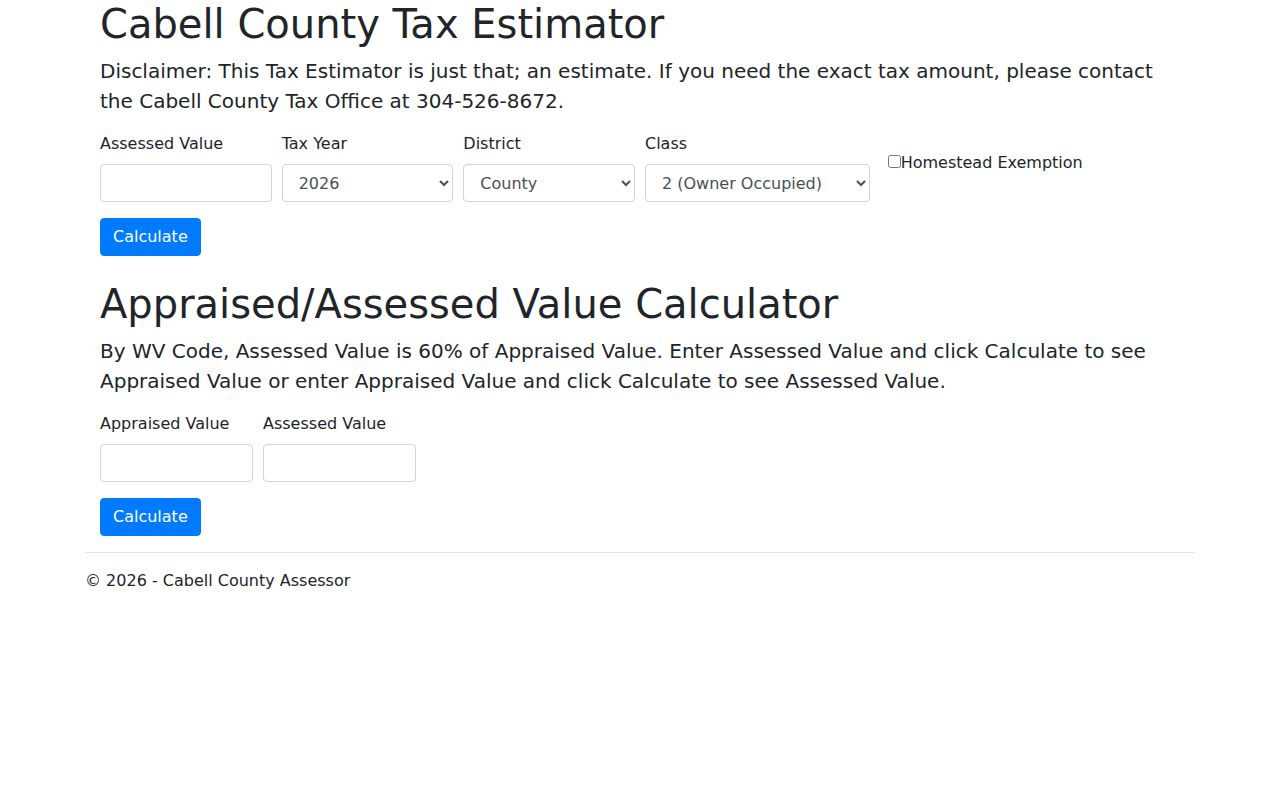
The estimator screen helps you see which choices move a tax estimate. It does not price a home.
Cabell County Sale Price and Assessment Come from Different Records
A prior sale lives in a recorded deed or related instrument filed with the County Clerk. The index search result lists parties, recording date, instrument number, book and page, and type. Not every Cabell deed states a price. The assessor card carries no complete sale-history field either. Read the deed itself and note exactly what it says about consideration, and never infer price from assessed value, tax paid, or a map.
A recorded price can reflect condition, timing, a related-party transfer, or a partial interest. In short, it may not resemble an open-market deal. Compare properties only when legal descriptions and dates match. Treat the recorded number as one piece of evidence. The deed index is a locator, not a valuation model.
Cabell County Property Value and Taxable Amount Can Differ
Class and exemptions change the tax math. The Assessor FAQ defines Class 2 as owner occupied, Classes 3 and 4 as non-owner occupied, and a July 1 to December 1 homestead application window. Homestead or disability filing can change tax treatment where the applicant qualifies. Confirm details with the current official instructions.
Never compare bills as if they were values. Bills mix in rates. Two parcels with similar assessments can differ in district rate, class, or exemption status. The tax bill reflects all of that. It shows what is owed.
Cabell County Property Value Depends on the Correct District
The 2026 Assessor FAQ lists separate local rates for Huntington, rural Cabell, Barboursville, and Milton. The map directory holds locality folders too. Barboursville and Town of Barboursville, Huntington Guyandotte, and Town of Milton each get their own. Confirm the parcel's tax district and municipal location before comparing values. A postal city or ZIP is not enough.
Huntington also spills into Wayne County. A Huntington address alone cannot tell you which county holds the deed or assessment. Use the GIS boundary and tax-map key first. Then verify with the Assessor. Rate schedules change, so recheck them for the tax year you are studying.
Cabell County Annual Maps Are Not Annual Appraisals
The county's PDF tax map folders run year by year through 2026. Each locality folder carries its own date. A newer map is useful for pinning down a current parcel reference. It does not prove every Cabell County property was revalued in that year. Assessment records, GIS geometry, and recorded deeds all change on their own schedules. So a map date is only a map date.
When a figure looks off, ask the Assessor about it. Find out which appraisal year and which parcel components the amount reflects. Confirm that a deed record and the current assessment describe the same land. Do this before comparing them. Never read an updated map timestamp as a value trend. The recorder's deed history and the assessor's tax roll simply move at different speeds.
Cabell County Property Value Is a Record Figure, Not a Guarantee
Cabell County publishes no complete, searchable assessor card with exact value fields. No countywide market trend sits in the public record. So a specific value question belongs with the Assessor. Take the parcel number and assessment year in hand. A market estimate takes separate evidence. A recorded deed, a tax estimator, and an assessed value differ. Each answers a different question entirely.
Keep three figures labeled in your notes: assessed value for taxation and the full-value estimate from the assessment process. Add documented consideration where a deed states it. The owner of record may match across all three. Do not collapse them into one "property value" number. Name the source and date behind it. Property records reward that kind of care.