
How a Cabell County Property Search Moves from Address to Record
Most searches start with a street address. They get stronger once you find the county tax-map key. The Assessor connects the public to a current GIS Experience and PDF tax maps. The office publishes no text-search property-card page with address, owner, and parcel fields. The Sheriff Tax Office takes a different route. Its detailed tax search digs into ticket-level detail. The County Clerk IDX indexes recorded instruments by name role, date, type, and book. It does not index them by street address.
Keep the address, legal description, map key, and owner name in one place. Do this as you move between portals. The same person can appear with initials, stray punctuation, a trust name, or an LLC suffix attached. A Cabell County property search is really a matching task. Your goal is to confirm that the parcel in one office is the same land described in another. Compare the parcel number closely.
- Open the Cabell Assessor GIS Experience or tax-map directory and locate the property by address or a known parcel reference.
- Write down district, map, parcel, and sub-parcel exactly as shown; do not guess digit count or leading-zero format.
- Use those fields in the Sheriff search, then compare the taxpayer and tax year with the parcel you identified.
- Search the County Clerk IDX using likely grantee, grantor, date range, type, and book to find the recorded instrument.
- Compare the deed’s legal description to the map and ask the custodian about images, older books, or a certified copy.
What a Cabell County Property Search Result Can Show
The Assessor's online text pages do not expose the card fields, so no particular owner label or sale-history field can be promised from that source. The Sheriff portal is clearer on its side of things. It supports a tax-key search returning taxpayer name, account, year, and ticket information. The County Clerk sample index shows a different set of document fields entirely. Treat each result as an office-specific record. When details matter, use the matching instrument or bill itself.
| Taxpayer / account | Name and account fields in the Sheriff tax search; verify the returned ticket with the Tax Office. |
|---|---|
| Situs and mailing | Property location and tax-mail destination are distinct clues; a mailing name alone does not prove title. |
| Tax-map key | District, map, parcel, and sub-parcel connect the tax ticket and map reference. |
| Assessed value and class | Use Assessor sources for appraisal, assessment, class, and exemption context. |
| Book, page, and instrument | The Clerk IDX result can show recording date, instrument number, book/page, pages, names, cross-date, and type. |
| Last transfer | Search the deed index by the parties and confirm the instrument; the landing page does not promise a sale-price field. |
No search result shows every unrecorded agreement. It also does not settle a boundary or certify that a lien is still open. Confirm the complete instrument and any later release, satisfaction, or court order. A GIS outline and an assessor entry are useful for matching land. But neither is a title search or a survey.
Choose the Right Cabell County Search Key
Pick the key that fits the office. An address finds the mapped parcel. An owner name follows parties through recorded documents. The full tax-map key matches a ticket across county resources. In Cabell, the Sheriff's search fields make the district-map-parcel-sub-parcel sequence especially useful. The Clerk index is name- and instrument-oriented instead. An address must first be translated into a legal description. It could also become a current owner or parcel clue before it helps there.
| Search Key | Best For | Where It Works | Watch Out |
|---|---|---|---|
| Street address | Locate one parcel and confirm situs | Assessor GIS and tax-map PDFs | Mailing city, ZIP, and boundary are not the legal description. |
| Owner or entity | Find a deed party or tax account | County Clerk IDX; Sheriff taxpayer fields | Try punctuation, initials, trustee, estate, and LLC name variants. |
| District-map-parcel-subparcel | Match a Cabell tax ticket and map | Sheriff tax search and Assessor maps | Copy every component exactly; digit syntax is not verified in the research. |
Not a title search. A Cabell County property search gathers records held by several offices; it does not prove clear title or that a map line is surveyed. Use a title professional or licensed surveyor when those determinations are needed.
- Situs address
- The street location used to identify the land, which may differ from a tax mailing address.
- Tax-map key
- The Sheriff portal’s district, map, parcel, and sub-parcel fields used to locate a tax account.
- Grantee
- The party receiving an interest in a recorded deed.
- Owner of record
- A name shown in a public source; the exact Cabell assessor field label was not verified.
Cabell County Tax Search Uses a Four-Part Parcel Key
The Sheriff Tax Office portal offers the clearest search-field list. It matches a Cabell property to a ticket with ease. A street address can lead you to the right map. But the portal splits district, map, parcel, and sub-parcel into separate fields. Copy those values from the map or an existing tax record. One long parcel string should not be treated as universal. The portal does not publish its exact digit count or leading-zero rules. So follow the field structure as displayed.
| Portal field | What to enter | Search purpose |
|---|---|---|
| Taxpayer name | Last and first name | Find an account when the tax-mail name is known. |
| Account number | Taxpayer account identifier | Return a known account directly. |
| Year, ticket, suffix | Ticket year plus number and suffix | Locate a particular tax ticket. |
| District, map, parcel, sub-parcel | Each component in its own field | Match the GIS/tax-map location to tax status. |
| Year limit, real/personal, paid/unpaid | Choose applicable filters | Narrow ticket history and status. |
The portal does not guarantee any particular paid date, levy breakdown, or balance layout in its results. For an exact amount or status, call the Sheriff Tax Office at 304-526-8672. That is the practical lesson. A property search needs both a portal and a custodian check.
Cabell County Clerk Search Matches Names to Instruments
Once the parcel and likely owner are known, take the question to the Clerk IDX. The goal there is to locate the deed or other instrument. The interface offers Starts With and Exact Name Filter options. It also has index groups and sub-indexes, multiple types and books, and distinct Index Search, Image Search, and Vault Indexes Search modes. Search the current grantee first. Then search the prior grantor as a grantee in an earlier interval when the goal is a transfer chain.
Result rows can show an index/image flag and status. They may also list a recording date, document or instrument number, book and page, page count, sub-index, name, cross-date, and instrument type. PDF and Excel exports are available in the interface. The public landing page does not state when every image is available. It also does not say what an image costs. A name match alone proves little. Compare book and page, plus the legal description, to the parcel before treating a result as the same property.
Property search gets less reliable when a trust, estate, or business entity holds title. Use the exact entity name from a deed when you can. West Virginia's Secretary of State business search can help identify an organization or agent. Still, it does not replace the county's recorded instrument. The Assessor site links to Cabell's parcel and map resources.
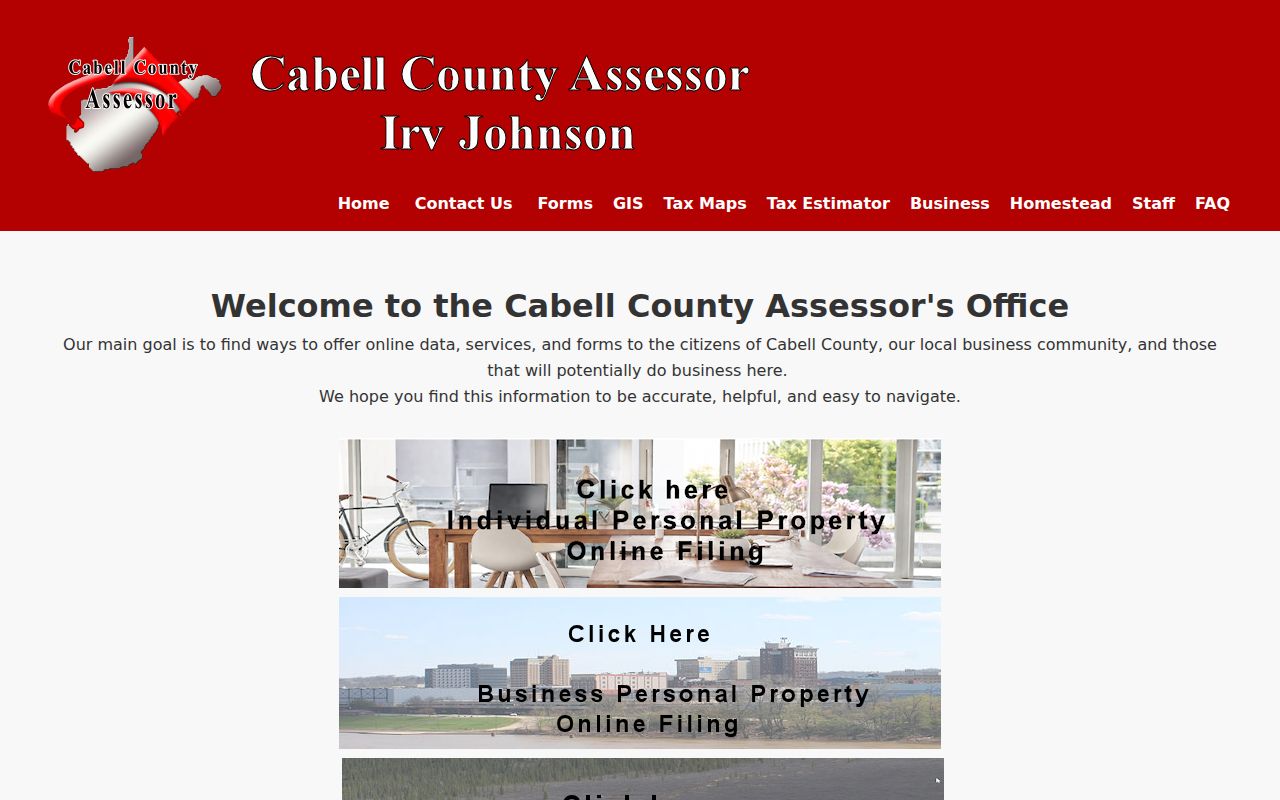
Use this landing page to reach the mapping resources that establish the county parcel key. The page itself does not offer a verified property-card search form.
Cabell County Property Search Separates Mailing from Situs
A Cabell County property search turns on one habit: never confuse the mailing address with the situs. The mailing address is simply where tax notices go. The situs describes where the parcel actually sits. The two diverge when an owner lives out of state, routes mail through a business, or relies on an agent. A tax account name can differ from the occupant too. So a tax mailing name proves nothing about who holds the current deed or who lives in the building.
Local geography makes the split matter in practice. Huntington addresses cross city and county edges, and a city label or ZIP code never establishes the tax district. Barboursville sits mainly in ZIP 25504, and Milton in 25541, yet postal boundaries reach past town lines. Pin the location in GIS first. Then work from the tax-map key and deed description. For older lots, check historic labels such as Guyandotte or Huntington Guyandotte instead of assuming a modern mailing label always applied.
Cabell County Assessor Card Search Has a Verified Limit
The Assessor's website ties together GIS, annual tax maps, forms, homestead material, an FAQ, and an estimator. The site offers no text-search property-card interface with address, owner-name, or parcel fields. That gap matters for anyone planning a Cabell County property search. The practical route is the current ArcGIS Experience or the PDF map directory. Follow that with a call to the Assessor for owner of record, class, exemption, and assessment details that stay off the screen.
One more wrinkle deserves attention. The legacy GIS page states it stopped updating in June 2026. That page links to the new ArcGIS Experience. A saved bookmark may still point to the old viewer, so follow the Assessor's current link before trusting any parcel display. When a record is not online, ask the custodian how to inspect or request it. A West Virginia FOIA request must describe the material with reasonable specificity. It follows statutory response and fee rules.
Cabell County Property Search Ends with Record Matching
The last step of any Cabell County property search is matching, not collecting. Once you have the address, key, tax ticket, and deed result, compare the parcel's written legal description against the tax map and any recorded plat. If the question is a boundary line, treat the GIS polygon as reference only. Hire a surveyor for that. If it is a prior owner, keep working the grantor-grantee chain in the Clerk index and Archives books. Payment status belongs to the Sheriff Tax Office.
Keep notes as you go. Record the portal, the date range, name spellings, instrument type, and every parcel identifier tried. That discipline separates a true "no result" from a failed search. The wrong book, index role, or historic map label can doom an otherwise sound query. Cabell County's property records run deep. But separate offices and historic index gaps mean a single result is rarely the whole answer.