
What Cabell County Property Tax Records Show
Two records feed a Cabell County tax question. The Assessor estimates taxable value, sets the class, and applies eligible exemptions. The Sheriff's Tax Office keeps the account, ticket, tax year, and payment status. Value and classification questions go to the Assessor. Bill and paid/unpaid questions go to the Sheriff.
| Field | What It Shows | Where |
|---|---|---|
| Assessed value | Taxable assessment, generally 60% of appraised or true-and-actual value under state law. | Assessor |
| Class and exemption | Property class and homestead status affect the tax calculation. | Assessor and estimator |
| Tax year and ticket | Tax year, ticket number, suffix, and account key. | Sheriff Tax Office |
| Paid or unpaid filter | Search status for the selected ticket or account. | Sheriff tax portal |
| District-map-parcel key | Four-part parcel locator with a separate sub-parcel field. | Sheriff search and Assessor maps |
West Virginia's assessment ratio splits taxable assessed value from an appraised, true-and-actual estimate. A tax bill also folds in the district, the class, and any exemption. Any exemption that applies lowers the amount owed. A deed's consideration, meanwhile, reflects a recorded transfer rather than market value. No single figure prices the property today.
How to Check a Cabell County Tax Ticket
The Sheriff's public search offers several ways into a Cabell tax ticket. Search by taxpayer name, first and last. An account number also works. So does a tax year paired with a ticket number and suffix. The map key route splits into district, map, parcel, and sub-parcel, with added controls for tax year, real versus personal, and paid versus unpaid status. For a balance, payment date, or delinquency detail, confirm directly with the Tax Office.
- Locate the parcel key in current GIS or a PDF tax map; an address or postal city is not a substitute for the district and map.
- Enter the map key components or known taxpayer/account/ticket fields in the Sheriff Tax Office portal.
- Use tax year and paid/unpaid options to narrow the search, then confirm the ticket details with the office.
- Check Assessor class, assessment, and exemption records separately; verify any sale or redemption through recorded notices and the custodian.
- Assessed value
- The tax assessment, set at 60% of true and actual value under the cited West Virginia rule.
- Class rate
- The local rate applied according to property class and district.
- Homestead filing
- A relief application for eligible property; the Assessor FAQ gives a July 1 to December 1 application window.
- Tax ticket
- The Sheriff-side account record associated with a year and ticket identifier.
Reviewing a Cabell County Assessment
The Assessor appraises property. Assessed value follows the state's 60% rule, per the office FAQ. The FAQ publishes no appeal form or deadline. Never guess a filing date. Ask the Assessor which review process fits your assessment year and district, what evidence it accepts, and when the request must arrive.
Confirm the deadline. The verified July 1 to December 1 period is for homestead and disability applications, not a confirmed assessment-appeal deadline. Contact the Assessor promptly for the current appeal calendar and hearing steps.
Cabell County Property Tax Records Depend on Class and Place
The Assessor FAQ lists 2026 rates. They vary by place and class. Class 2 means owner occupied; Classes 3 and 4 mean non-owner occupied. A city label or mailing ZIP will not settle which district and class govern a particular parcel. Pull the map key before any comparison. Then verify the actual ticket.
| Locality in FAQ | Class 2 | Non-owner class listed | Use note |
|---|---|---|---|
| Huntington | 1.67520 | Class 4: 3.35040 | Confirm city and tax district for the parcel. |
| Rural Cabell | 1.35520 | Class 3: 2.71040 | Rural district is not a municipal mailing label. |
| Barboursville | 1.73020 | Class 4: 3.46040 | Check boundary and the Assessor map series. |
| Milton | 1.60000 | Class 4: 3.20000 | Confirm Town of Milton parcel context. |
The FAQ's 2026 schedule is the source for these rates. Recheck them before use, since assessed value, district, class, and exemption status still drive the actual tax amount.
Cabell County’s Estimator Is Not the Final Tax Bill
The Assessor-linked tax estimator asks for assessed value, tax year, district, class, and homestead exemption. It returns an estimate, not a bill. The Tax Office must confirm the amount due. Keep the two tools separate. The calculator projects from inputs. The Sheriff search is the account route to an actual tax-year ticket and payment status.
The estimator also reflects West Virginia's 60% relationship between assessed and appraised value. That ratio does not make its output a sale appraisal. Enter the wrong district or class and the result can mislead, even with correct arithmetic.
Before relying on any calculated amount, open the Cabell tax estimator to review its input fields. Read its own warning too.
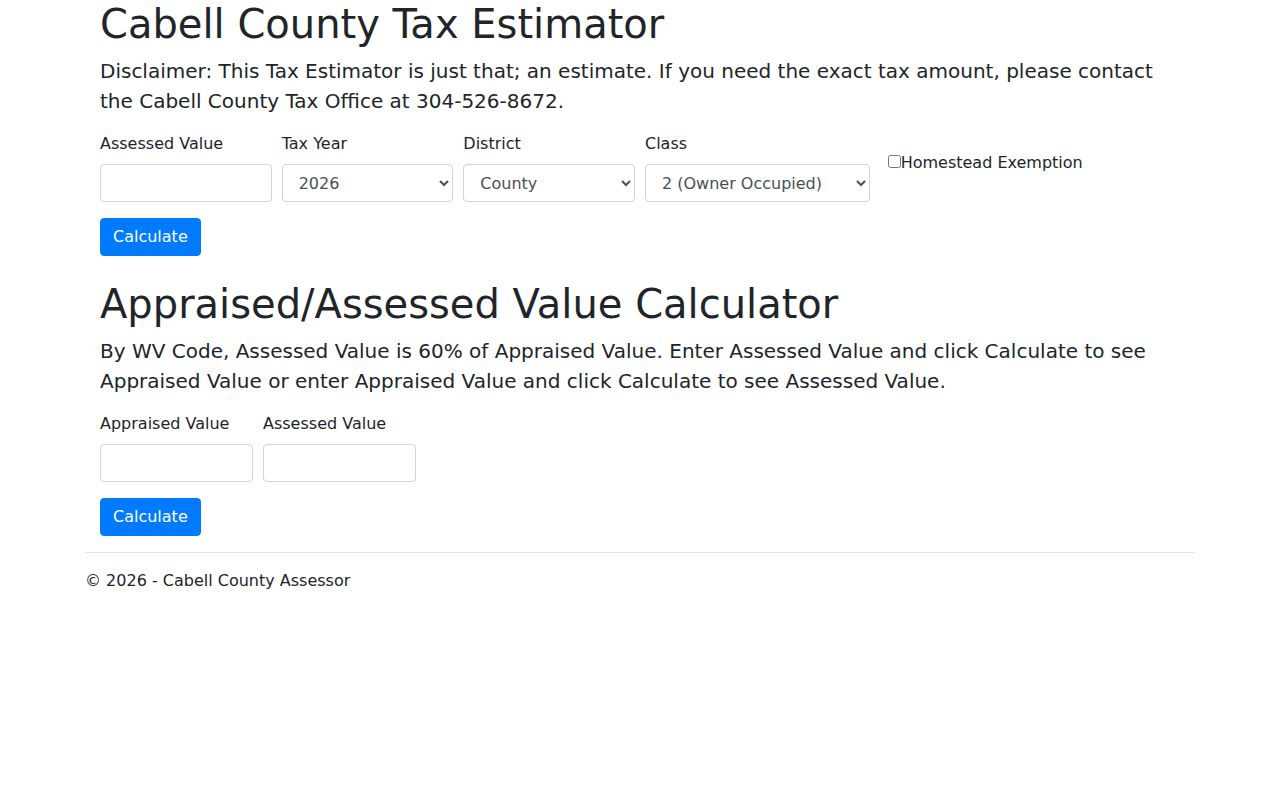
The estimator's own page shows the assumptions it requires. Confirm the parcel's class and final bill with the County Tax Office before relying on a calculated amount.
Cabell County Homestead and Filing Dates Need Their Own Check
The Assessor FAQ sets July 1 through December 1 as the homestead and disability application window. Applicants must be at least 65 and a West Virginia resident for two consecutive years. Eligibility begins when the applicant turns 65 before July 1 of the upcoming year. Other filings have their own deadlines. Personal-property returns are due October 1. Farm-statistics reduction runs July 1 through September 1. Business personal-property returns are due September 1. These are separate filings with separate purposes.
Dates and eligibility guidance can change, so confirm the requirements with the current FAQ and application forms before filing. An exemption flag in an assessment record does not prove an application was approved or match the bill produced for a given year. The Cabell Assessor FAQ carries the current filing and class information.
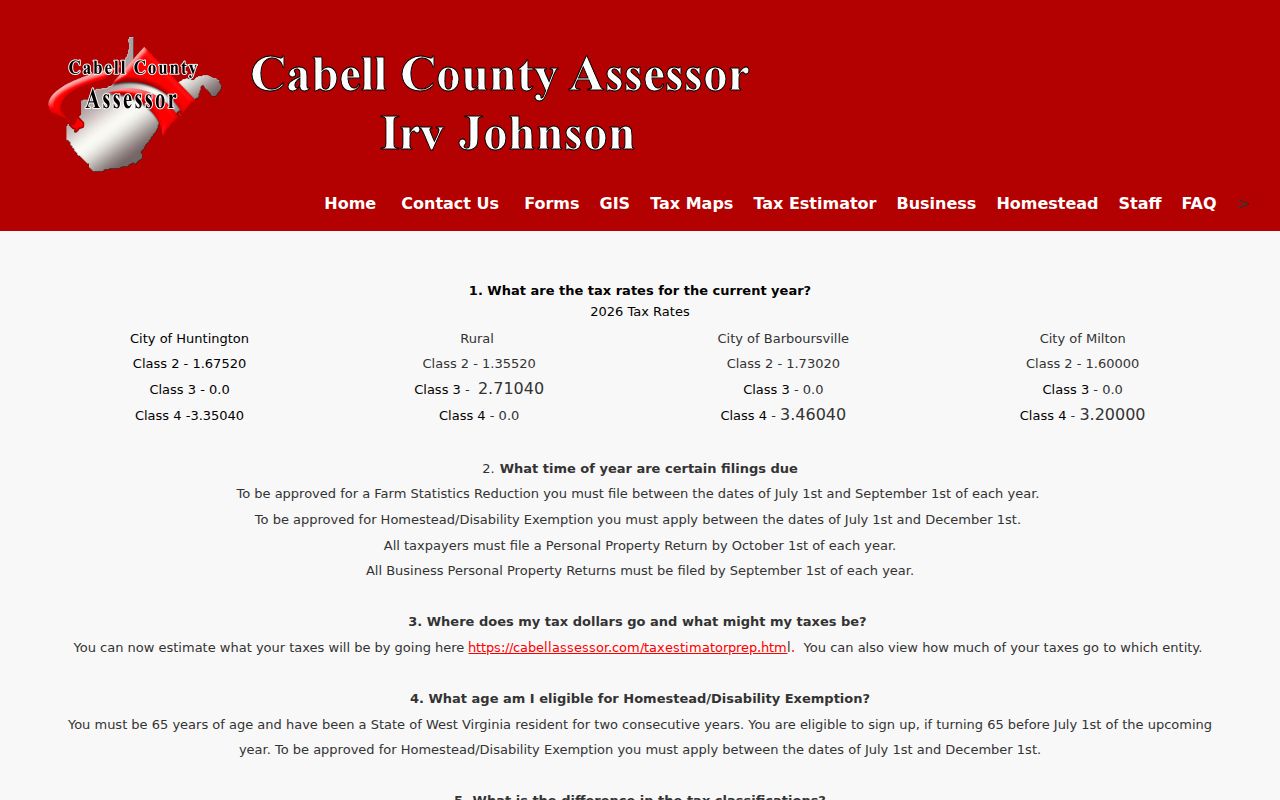
Use the official FAQ as the starting point. Then contact the Assessor about a specific property or filing question.
Cabell County Tax Delinquency Is Not Proof of a Completed Sale
For a delinquent property question, compare the Sheriff ticket status with County Clerk instruments. Also check any court docket. The Clerk index covers records of delinquent land, foreclosure bonds, reports of trustee's sale, certificates of redemption, deeds, releases, and related types. A delinquent ticket alone does not mean a tax sale happened. The Sheriff publishes no current official sale calendar or complete delinquent-list page. Contact the Sheriff Tax Office at 304-526-8672 about current notices and procedures.
If a sale is reported, check the sale notice, redemption status, resulting deed, and any release or court order. Compare the effective sale date with the recording date. For a court proceeding, use WVPASS or the relevant clerk file. The land-record index and the court docket answer related but different questions.
Cabell County Tax Maps and Tax Tickets Serve Different Jobs
Tax maps and tax tickets serve different jobs in Cabell County. Assessor maps identify district, map, parcel, and sub-parcel. The Sheriff portal takes those components to find an account or ticket. A map shows no payment status. A ticket proves no legal boundary. The Assessor's PDF directory holds annual Cabell County maps. It also keeps separate locality folders for Barboursville, Town of Barboursville, Guyandotte, Huntington Guyandotte, and Town of Milton.
For parcel work, use the same tax-map key at each office. Then confirm the legal description matches. Town names, ZIPs, and GIS lines are only supporting context. The County Clerk's recorded deeds and map-book records remain the route to the instrument. The legal description sits there too.