
How to Find Who Owns a Cabell County Property
The route to an owner name runs through three Cabell County records. Start with the address. The Assessor's GIS and tax maps turn it into a district and map. They also give the parcel and sub-parcel key. That key drives the tax search. It points to a likely owner. But confirm the name in the County Clerk's deed index, where the newest instrument names the actual grantee. The deed is the proof. Treat the GIS and tax layers as signposts. Cabell County publishes no guaranteed online assessor owner card.
- Locate the parcel using the address and current Assessor GIS or PDF map series.
- Use the district, map, parcel, and sub-parcel in the Sheriff tax search to find the relevant account.
- Search the County Clerk IDX for the newest deed, checking the party shown as grantee and the legal description.
- If a business entity is named, use the West Virginia Secretary of State search to understand its filing identity, then return to the deed for the property interest.
- Use a tax mailing address only as a lawful correspondence clue; it does not establish occupancy or title.
Where Cabell County Owner Information Appears
Cabell County offices record a party's name for their own reasons. The Clerk indexes a deed's grantee. The Assessor keeps the assessment data. The Sheriff's tax portal searches a taxpayer account. The GIS is a parcel locator whose attribute panel has to be opened directly to see current details. None of these is a directory of occupants, and Cabell County publishes no text-search assessor card with a precise owner field.
| Source | Owner Info It Gives | Access |
|---|---|---|
| Assessor | Assessment, classification, exemption, and parcel context; owner-card field needs direct confirmation. | Assessor site and office |
| County Clerk IDX | Recorded grantee, grantor, instrument date, type, and book/page. | Public index; image access varies. |
| Sheriff Tax Office | Taxpayer/account and the ticket search key. | Public search and office confirmation. |
| WV Secretary of State | Entity, organization, agent/officer, and business filing details. | Public business search. |
A deed names the parties to a transfer. An assessment or tax account may show a taxpayer or owner name. Neither tells you who occupies the building. Mailing and situs addresses can differ, too. When the same name shows up on several Cabell County records, match the legal description, instrument date, and parcel key before assuming they describe the same land.
Limits on a Cabell County Owner Lookup
Public records have honest limits. A recorded grantee or a tax-account name does not confirm who lives at the address or who uses the building. Title is rarely simple. A deed may vest Cabell County land in an LLC, a trustee, an estate, or several parties at once. West Virginia also runs an Address Confidentiality Program. Its rules protect certain personal details, and public access is not permission to republish sensitive facts that serve no purpose.
Lawful use. Use Cabell County ownership records for property research, transaction diligence, and history. Do not use a name or mailing address to stalk, threaten, or harass any person.
Who Owns a Cabell County Property Is Confirmed by the Latest Deed
The newest recorded deed is the strongest public evidence of a transfer. Search by grantee name. Add a date range. Then open or request the instrument, and compare its legal description with the GIS or tax-map parcel before trusting the match. Later paperwork can change things. A release, corrective deed, certificate of transfer, death deed, or court order may affect how the record reads. The Clerk's IDX landing page promises neither a complete image set nor a stated copy charge.
Assessor and Sheriff records still matter. They connect land to tax administration. A tax record that still lists a prior taxpayer after a sale usually reflects slow updating, so compare it with the recorded deed rather than doubting the closing.
Cabell County Property Owners May Be Listed Through an Entity
A company name on a Cabell County deed opens another door. Search the exact legal name in the West Virginia Business Organization Search. Start with the basics. The basic fields are Organization and Agent/Officer/Name. The guidance recommends the percent sign as a wildcard. Advanced search adds organization types, business type, charter type, date ranges, active or inactive status, and purpose codes. Those results can explain an entity's state filing and name variants.
For that lookup, use the West Virginia Secretary of State organization search. It exposes the organization and agent/officer/name fields.
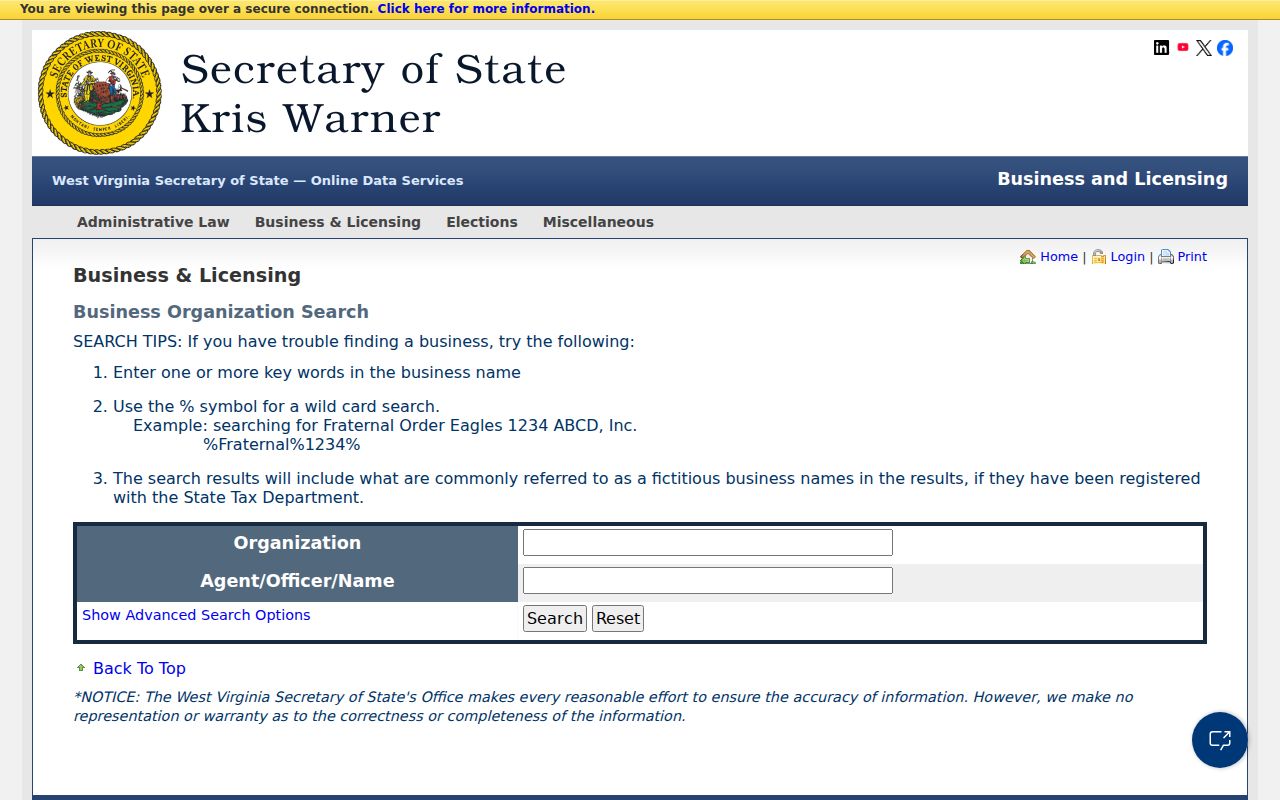
State filing fields clarify a company's legal name and registered-agent record. They do not identify the owner of a Cabell parcel. Go back to the deed. A registered agent is a service contact, not a beneficial owner or occupant. Trusts are indexed under trustees. Estates may appear under a fiduciary or an "estate of" name. The deed controls. Use its exact vesting language. Return to the County Clerk record for the land itself.
Cabell County Owner Names Need a Situs and Mailing Check
Two addresses travel with every parcel. The situs address shows where the Cabell County property lies. The mailing address shows where tax notices go. They can point to different places, and the mailing recipient may be an entity, trustee, or agent. Cabell records span river-city and rural settings, and Huntington extends into Wayne County. Check the parcel's county and district instead of trusting a city name or ZIP.
Map labels add another wrinkle. Barboursville and Town of Barboursville appear as separate map-directory labels. Milton has a Town of Milton series. Older records may use different geography, so these labels help, but they prove neither municipal boundaries nor ownership. The deed and parcel description remain the matching evidence.
Who Owns a Cabell Property Can Change Through Probate
Probate changes who owns a Cabell property. When an owner dies, search the Clerk's Estates and probate case types alongside the deed records. The IDX lists wills, fiduciary orders, executor and administrator bonds, death deeds, certificates of transfer, and heir affidavits. A will alone may not move the land. Follow the fiduciary appointment, then the deed or certificate of transfer, until the parcel reaches its current owner of record.
Vital records help only within state access rules. Birth records generally open after 100 years; death, marriage, and divorce records after 50. Some fields stay protected. A death certificate is not title evidence. Tie it to probate and to the recorded instrument that actually conveys the property.
Cabell County Owner Search Has Known Gaps
Cabell County owner searches have known gaps. The county publishes no property-fraud alert signup, no searchable owner-card URL, and no exact public field label for the assessor's owner of record. The precise lag between a deed recording and a visible tax-roll change is likewise unstated. Ask the office directly rather than guessing. For a new transaction, compare the latest Clerk result with the assessment and ticket. Note the date of each check.
An empty result is rarely the whole story. Try reversed name order and punctuation variants. Switch the grantor and grantee roles, alternate document types, and widen the date range. For older transfers, move to the Archives index and the deed books. A blank screen describes one search path, not the full ownership history.